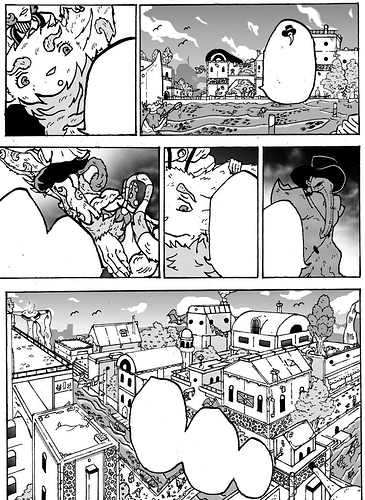
Lots of people are giving good advice about your example, so I'm going to talk about the question more generally: how do you draw good interesting backgrounds, which is both difficult and time-consuming. Specifically, I'd like to share a "trick" that has helped me a lot. This came as advice from indy creator Jeremy Dale, but originally the idea came from the great Will Eisner. And his idea was simple: if you draw one rich, detailed background to open your scene, then in subsequent panels you can maintain that sense of setting just by adding simple little hints of that original image.
It makes sense in terms of how we read scenes: when we are someplace new, we explore the environment to learn where that is; hence the importance of the "establishing shot" in both comics and film. However, as the narrative moves forward, we focus on the character drama, and the background fades into... well, the background. 
It's an approach that saves time and energy by letting you pour your effort into the places it will count. Personally, I tend to add background detail when the characters interact with the environment as well, and often to close a scene. But I also like to let it recede when I can, relying on the high impact shots I've already drawn. In this chapter: Swords, I do a fairly detailed backgrounds (for me) to open and close the scene, and some moderately detailed shots throughout as well. However, I also have a bunch that are really minimal; just a brown background with a gradient. And I also re-use sections of my detailed backgrounds for places where I just need a hint of the environment. And, when the shot stays the same, I just literally use the same cut-and-pasted background behind different figures.
That's my personal balance of variety and economy, but what's helpful is knowing when it matters most to have a detailed environment; first and foremost when a scene opens. And also that you can maintain that sense of presence by adding just one detail of that environment into following panels. Here's a quick example from Eisner; just three panels, but each of the latter two make reference to the super-detailed original, while themselves being far simpler: 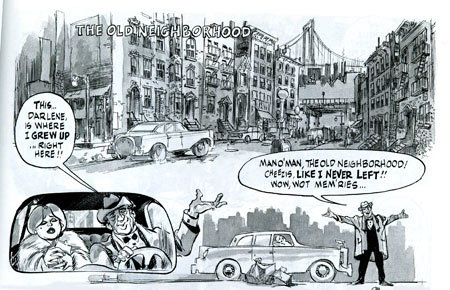
Anyway, that's my $.02, hope it helps,
Adam