The way magic works in Legends of Camelot hasn't been officially explained yet in the story, but some aspects were hinted.
For the ones curious about it, here are the basics:
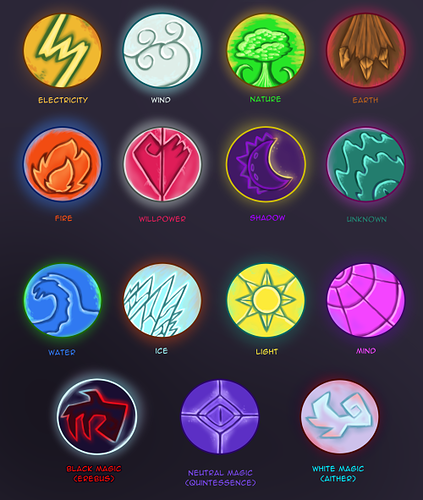
-The act of doing magic comes from reading and writing the language of gods. This language comes in the form of symbols.
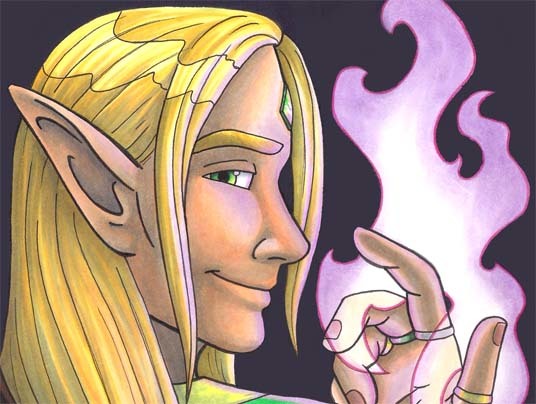
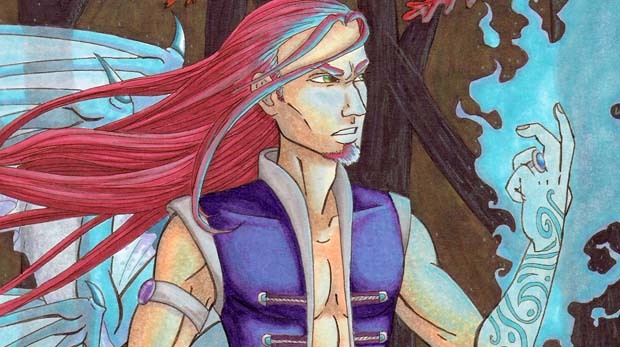
-For that purpose different mages and casters take different approaches, some carry runes with the symbols, others scribe them in their weapon or gear, others get their preferred symbols tatooed and some write them in the air doing sophisticated magical gestures on the spot. As long as the mage can properly read and has the symbol properly written, any combination of the previous methods or new ones are theorically possible.
-Magic consumes a spiritual energy that comes from the user's soul. Some call it mana, others chi, ki or whatever, but the everyone has their source. This can be trained just like a muscle, and takes hardwork and practice to have a bigger mana pool. The bigger the change of reality performed by the spell, the bigger the cost of mana. One can spend extra time focussing on the spell to channel the mana in an optimized way, but leaves you vulnerable in a combat situation.
-Because magic is connected to the user's soul, a user's affinity to different magic symbols will depend of their background and personality. For example: A sculptor will have a higher affinity to spells related to stone and a pacifist will have a lower affinity with spells with the symbol "destroy"
-A spell last as long as the user is focussed on it, but the indirect consequences of it stays: for example, a flame created by magic dissappears when the user is no longer focussed, but the things that got burned by said flame stay burned.
-The effect of a spell is defined by a combination of symbols. There are 4 types: nouns, verbs, adjectives and adverbs.
For a spell to work you need at least one verb and one noun:
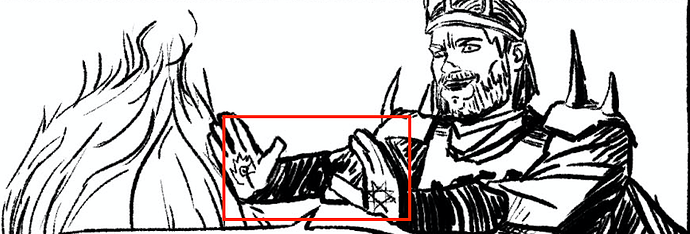
For example: "create fire"
As you can see, king Uther has tattooed the symbol of creation in one hand and the symbol of fire in another, allowing him to create fire as long as he has enough mana.
The interpretation of the symbols is literal: the spell "create fire" doesn't give the user control of said fire, for that they would also need the verb "control". And the spell "control fire" doesn't create the fire, only gives control over a body of fire that is at the range of the user....
A single combination of symbols can be cast in different ways depending on how much mana an user spends and how much time do they focus on proper channelling of said mana:
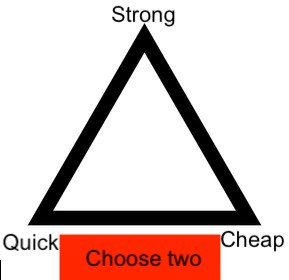
As a general rule, it follows the "choose two" rule:
-A quick and cheap spell will not be strong (commonly called cantrips)
-A strong and cheap spell will not be quick (commonly called rituals)
-A quick and strong spell will not be cheap (those are called spells)
-Metamagic symbols are not neccesary for a spell, but some mages study them to boost their magic in different ways
-adjectives allow to overcome the regular limitiations of magic, but cost aditional mana. The bigger the limitation they overcome, the bigger the aditional cost
Examples of adjectives: "Silent":(allows casting a spell without reading out loud the symbols), "Independent": (allows to maintain a spell for some time without concentrating on it), "Cooperative":(allows an user to cast a spell with another mage) among many other possibilities
-adverbs are the opposite, they add aditional limitations, but in exchange, they lower the complexity of a spell, allowing stronger effects. the bigger the restriction, the bigger the boost in power one can achieve:
examples of adverbs: "slowly"(you need to take your time casting), "at full moon"(the name says it), "angrily"(the spell will only work if you are angry), "loudly"(you better shout the hell out of your spell)
Adjectives and adverbs are also affected by affinity. For example, a loner will have low affinity to the "cooperative" symbol and a bard may have a high affinity to the adverb "musically"
Is kinda long, but i plan of introducing the concepts gradually and organically through the story