Salutations! Well, I gave your comic a read and I figured I'd give you some feedback.  Before all that your username makes my day. Haha I have to admit I had a little chuckle when I saw that.
Okay, onward! So, story wise I think you've got a good premise here, a young slave girl is rescued (even unbeknownst to her, as she thinks she's just been sold, which is a very good storytelling touch to establish her frame of mind as we start), rehabilitated and shown the world in essence, for the first time, all while holding onto a secret. It's a premise with a lot of promise and so far you've got a good start on it. Your characters are all noticeably different from each other so I know who everyone is upon sight AND I know them all by name, which is also good. You've dropped some hints here and there to start the story off with some intrigue about what Mercy's secret may be, and then given each character a good establishing personality. Nobody feels interchangeable so, good on you!
There are a few technical things that you've run into that I want to share with you so when they happen again, you can catch them. One is the use of the asterisk to denote emotion. Specifically the use of "*Rolls Eyes." Using the asterisk like this is actually very distracting, even if you've seen it used in manga or things of that nature, this is a very visual medium so, you need to SHOW us that Lee is rolling his eyes. You can do this by creating two frames of his face and just show him rolling his eyes using one frame as a starting point and the next as an end or, you can draw a single picture of Lee and show his expression (eyebrows are important with this one) denoting that he had rolled his eyes. (Usually this is done by having the eyebrows slightly down and his eyes looking up into his head) Here's an expression chart so you can see how some facial expressions are made which include use of the entire face to tell a story. (There's also some different styles in there!)
Speaking of expression, that's another thing we've run into here: body language! Now, I will say that I think you've done a good job with everybody's body language so far. Mercy is always slouched, has her hands in front of herself as if to protect herself, Lee is cagey with folded arms and a disinterested mien belying what he actually cares about, Mrs. Withers is very open and often puts her hands out to others in that comforting way and of course, Orrick has very open posture which denotes the kind of person he is, so very good job in using soft cues to establish who everyone is personality wise! The trouble comes with the fact that, everybody is still very stiff. Like a rig. Which I did notice you use a lot of 3D models that you integrate with the art which ISN'T a bad thing on the whole, however it's very distracting when looking at a piece and some of it is drawn, while the rest doesn't feel like it belongs there.
This really hampers your ability to get expression out of body language too because 3D models can only go so far, and even if you trace over them at any point, they're still stiff. So my best advice here would be to study figure drawing. This will also go a long way towards helping your expressions out too! It'll make your faces, eyes, smiles, frowns, all feel more substantial and come across stronger, the less you depend on the 3D modeling software you're currently using. Now, that being said I won't tell you not to use it at all, because by doing so you're learning things about perspective, spatial relations, and so on, but what I'd suggest is while you use this software, take time to draw by hand and learn how to draw the objects you're moving around in the 3D space. Hell you could trace over them in your sketchpad just so you can start getting your hands used to drawing them. Just remember that to get your work as expressive as possible, you've a lot of practice that you can do, to really shine up the good work you've got so far.
Now, onto the next thing I think could really help your art: Textures! No, not the back ground kind, hahah. You're doing fine with those so far. I mean for clothes! Everybody's clothes looks stiff, now I know Mrs. Withers cares a lot but she needs to lay off the starch! (I kid, I kid. One man's starch is another man's...well starch.) Anyhow, the 3D models don't really give you a lot of options with regards to clothing and clothing textures and even if they did, they'd never be quite right, since they're in a 3D space and are made to reflect that. My best advice here would be to look at dresses, shirts, pants, drapery, the lot to get an idea of how different kinds of fabric folds, falls, and crumples. Everybody has a look that tells me who they are, but they all look stiff in their clothes and it breaks my suspension of disbelief when my mind keeps getting distracted by how rigid everything is. Don't worry, just like with figure drawing, there are lots of resources for tackling textures too!
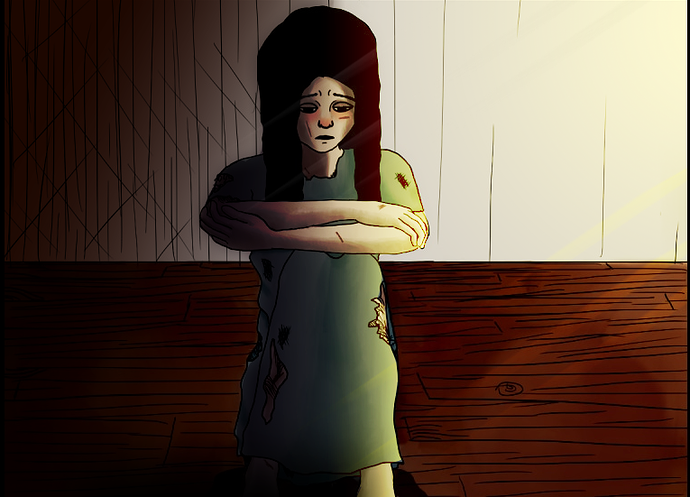
After all that, the next thing that'll make it all come together with a pop is values! Ie. Shading, Lighting, and so on. You do have some shading here and it's a great start, but you tend to have the same lighting for every room of the house during all hours of the day (at least what I've seen), and that doesn't really tell me the mood of the world or the mood of the room. It's easy to shade a character and think that's the end of it but, part of building atmosphere is the shading or lighting of a room or a moment. It gives the audience soft cues as to how intense something is. To this end, I've taken a panel of your comic and given it more lighting and shading to denote Mercy's emotions. Here:
Now, I didn't do anything fancy, these are very quick edits and not to the detail I'm used to working in but, for an example it'll do. See how it changes the entire mood of the scene? Since the time of day is always the same when you show the outside of the house, I decided to run with a sunset vibe for this (primarily because the shading would really give to the feeling that the sun is setting on her previous life and she has no idea where it's going). I wanted to evoke her uncertainty, here she is in a house full of strangers yet again, and the light outside is dying while the darkness on her shoulder threatens to take over. You can evoke fear, sadness, hopelessness and all without saying a word. Lighting can have a profound effect on how a character and indeed, a scene, touches your readers. With a story as emotionally potent as a slave girl getting a new life for the first time, little touches like this can make all the difference. My advice to you here as well is, watch your favorite movie, see how the lighting in that movie makes you feel as you watch, and then you can use those techniques to really bolster your own work.
When we see a character surrounded by darkness and they're all alone, we know how isolated they feel, when we see a character surrounded by bright pleasant light we see how uplifted they feel. It's all these little things that can put a scene together in perspective and you don't even have to say a word. It's all about showing. Here's a tutorial about why lighting matters and how it can be used. While the vid IS talking about movies, it also applies to art very heavily so, I wanted to include it as referential material.
Now, one last thing: Talking V. Showing. Since this is a visual medium I want to get my cues from the visuals, not just from exposition. Mercy exposits a lot in the beginning and as readers, all we get are long swaths of blank space with text bubbles, which isn't very interesting to look at. Mercy explains to us things I really wish I'd seen, like her receiving her new dress. This is the FIRST time in her life she's been given something from someone who wasn't angling to hurt her, use her, etc. The first time she was given a real meal, we didn't get to see the surprise, shock, tears, of joy that she was allowed to eat real food, she just tells us she's surprised, so the scene which could REALLY pull you in with just the look on her face or the way she experiences kindness for the first time, just becomes speech bubbles and removes me, the reader, away from the scene or the emotion therein. You have SUCH a good story here, and I just want to see every small part that makes it a great story.
And while the writing can take you there to a degree (which, by the way, the writing itself is pretty good it just needs some small trimming here and there so you don't inadvertently repeat details and so on) since you're making a comic, I really want to SEE these moments, not just get a report that they happened off screen somewhere. The visual medium is meant for moments like that, more than any other kind, emotional deep moments can pull your whole comic from "good" to "great" in seconds.
Phew, by the gods I think we've hit the end haha. Good on you if you made it this far, I know I had a LONG swath of feedback for you, but I hope that all of it is helpful and that the resources I've provided make for good references for you. Like I said in the beginning, I really do think you've got a story here that will blossom and become something fascinating, and being that your writing is already pretty good, heck you're more than half way there! And, if you don't have a digital art program that you can work with other than the 3D program, check this out: FireAlpaca. This one is free and you can use it to apply shades, textures, etc. You can import images from other programs and draw over them, it's really a great help. I got my start with it and to this day I don't think I'd have learned as much as I did without it. I wish you luck with your comic and I'm gonna sub so I can see where it goes!
In keeping with the thread theme, you're also more than welcome to check out my work. HAH I can guarantee you're in for a lot of imperfections of mine as well! You'll even get to see some of the comic pages I made in FireAlpaca originally so, lol be prepared, they weren't pretty! (I was still new to digital art back then and even now, I've more yet to learn!)
Cheers and all the best,
-Syn.