I both write and draw my comic!
My process is to have kind of an outline of things that I want to happen, and then break that outline down into a list of pages with a Thing That Happens On Each Page (or a rough guess at that, at least), and then break that down into a script.
I don't pay a lot of attention to how long a scene takes, (to some extent, it depends on how you define "a scene," but I think it's normal for scenes to be different lengths) -- but since my comic updates with one page a week, I pay a lot of attention to how much happens on each page. If a scene has a lot of pages because a lot is going on, that's fine!! But if it's taking a lot of pages to do just one thing, that's when I try to cut some of those pages and make the scene shorter.
So for example,
Page 1: The bad guy runs and the heroes chase him
Page 2: the bad guy jumps a fence and jumps into the river, the heroes follow
Page 3: the bad guy is still running and runs into a cave
Page 4: the heroes keep chasing the bad guy through the cave, finally corner him.
is going to feel very slow if you're updating page-by-page, because nothing new is happening -- these can all be summed up "heroes keep chasing bad guy." You could cut this info down to 1 or 2 pages and it wouldn't lose any excitement.
But,
Page 1: guy stops by girl's house to say goodnight, she seems unhappy
Page 2: he asks her about it, and she finally snaps and admits she doesn't love him, he's shocked
Page 3: he pushes his way into the house and demands to know why she strung him along, she lashes out at him with ways he wronged her
Page 4: he gets angry and says something threatening, she runs away
you might think 4 pages of talking would be a bad thing -- but actually, for this example, something new is happening on each page. Pages 2 and 3 are a reveal of these people finally showing their true colours -- when a reader tunes back in after she's declared she doesn't love him, then on the next page learning why, and how he reacts to it, is interesting and builds something new on what happened last time!
In the Chase Scene example, if you tune back in for the next update to learn that "yup, they're still chasing him!" -- that doesn't feel as satisfying. On the other hand, if page 2 or 3 of the Chase example had the bad guy leaving a trap for the heroes, or hiding out somewhere that we know is dangerous, then something new is happening, and it becomes foreshadowing and tense.
So basically, if it's pacing you're concerned about, it helps me a lot to sit down and write little summaries like that of what happens on each page -- then I can see if I'm using a LOT of pages on something like "they keep fighting" and can think about how to cut it down.
If you want to write within a specific page count, Jesse Hamm has a really great method for doing that which I posted about here -- but this is the internet, and your chapters can be as long as you want! Mine tend to sit around 50 pages, which I try to keep consistent so that my book prices can be consistent -- but folks who have no plans to print chapters individually can kinda do whatever they want. Some people have 22-page chapters, some have chapters with over 100 pages. It varies a lot!
The thing that I ended up having the most trouble with was that I didn't plan some of my exposition. I wanted to get to the action as quickly as possible, and while I don't think that was a bad thing, there ended up being one point where I needed a whole page full of text explaining something that we really should have gotten in small pieces earlier. If I had been thinking ahead and going "okay, we need to know how this kind of magic works before we get to this point in the story," maybe I could've found a better place to put it.
There's a tendency to think of exposition as a bad thing and to try to avoid explaining things, but it's good for your readers to know what's going on so they can care about it!! You do want to avoid info dumps, but don't try to avoid exposition altogether -- instead, find good natural place to put that information before you get to the place where your audience will need to know it!
I do things like this in my notes now:
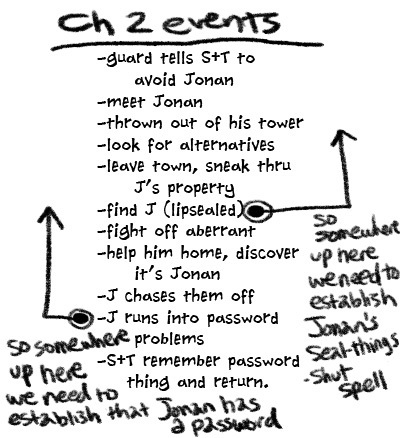
so that I can look at my notes and go "oh okay, so when the guard tells the heroes to avoid Jonan, she should mention how his magic works, and when they meet Jonan for the first time, someone should mention that his house has a password -- so when all of those things come together later, the audience will already know what's going on and I won't have to sit down and explain it all at once."
SORRY FOR THE EXTREMELY LONG POST, but I hope something here is helpful for you!! If anything here didn't make sense, or raised more questions than it answered, please feel free to ask me to clarify and I'll try to explain it a little more clearly. x3


