Getting the timing and pacing of panels right is legitimately tricky, and can take a frigging long time to get used to. If you are brand new to it, I really, really recommend reading Understanding Comics or Making Comics by Scott McCloud. He covers paneling and pacing and timing in a lot of different ways, and breaks it down into ways that really makes you stop and think about what you're doing and why you're doing it.
In general though, here are some things to keep in mind... Most of what I'm going to say applies to an actual page of comic art, as opposed to the scrolling format, but a lot should still cross over.
So if your script is, "Bob bends over to pick a flower, then he smiles at it, and walks away." That seems pretty simple, right? But depending on what you want to highlight as important, and how you want the pacing to work out, this one sentence can be anywhere from three panels to two pages.
If we do three similar-sized panels, we get this...
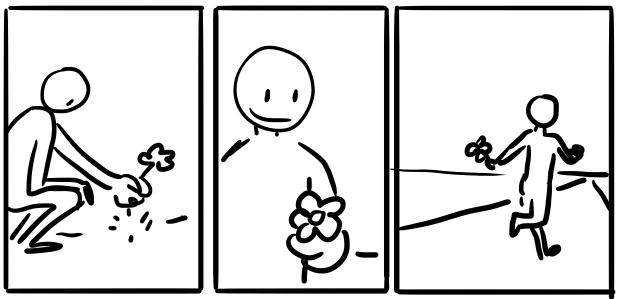
Bob picked up his flower, smiled at it, and walked away. The pacing is pretty quick, and the action is over relatively quickly. But if we wanted to draw this moment out, we could.
It's the exact same actions, just spread out across more than double the panels. It slows the moment down, makes it take a lot more time, and also makes it feel more important and significant. So the more panels you make an action take, the longer it feels to the reader, and the more emphasis is put on that action.
Similarly, the bigger you make a panel on the page, the more important that particular panel will feel. If we look back at our original three panels...

Every panel is about the same size, so each panel feels equally important. Nothing really stands out as significant. But if we do this...
Nothing changed about the art, I just copied and pasted the previous scribbles. But by making the middle panel bigger, it feels more important. It physically takes up more space on the page, so it takes up more space in time, and the reader's eye stops on it for just a second longer than the others.
Another way to play with pacing is by repeating the same or a similar panel several times. If we do this...
It gives us a totally different mood, and a totally new sense of time. Even more than just making that panel bigger, by repeating it several times, we get a different passage of time. Like he's contemplating the flower for a longer period of time.
The last thing I'm going to bring up is how you can alter the pacing of a page by changing the space between the panels, which is referred to as the gutter. If panel gutters are very close together, it makes it feel like there is very little time between those particular actions, giving the sense of things happening very quickly.
By overlapping the four panels in the middle, it gives the reader a sense that these actions are happening in very quick, rapid succession, maybe even almost simultaneously. Then, for the last panel, I removed the panel border entirely, which opens up the panel to the rest of the page, giving a sense of "open time," like that moment could last forever, because it isn't constrained by a panel border to give it a period of time to occur within.
Similarly, if you have a wider gutter between panels, it makes it feel like a longer period of time has passed between the panels.
So by placing very uniformly thin gutters on the first four panels, and then having a very wide gutter before the last panel, we establish a sense of pacing for the first four panels, that is then broken by the wide gutter. The sudden difference lets us know that something different is happening, and implies a greater passage of time between looking at the flower and walking down the street.
Anyway, hopefully some of this is useful. It's by no means all-encompassing, and if you read those Scott McCloud books he definitely goes into a lot more detail about it. But basically, when you are planning your page, think about what your most important actions are, how long you want those actions to take, how quickly things happen, and what you want the reader to spend the most time on with each page. Those should help at least get your thoughts going in the right direction.