1. Go to the source
What do you imagine when you think of an 'exaggerated action pose'? Who draws these pictures, or creates these images? Find their stuff and study it. If you can find out who they learned from, find that person's stuff and study it, too.
Basically, try to focus on whatever's closest to what YOU want to create, and whatever's closest to that, and so on. Don't just look up nondescript 'action poses' from anywhere-- you'll end up presented with a million different ideas of what constitutes an action pose, and it's very difficult to learn a million different things at once.
For example, if you imagine real people fighting...look up real people. Study the live-action films where you've seen fight scenes that you like; look at videos and photos of real people performing martial arts.
On the other hand, if you imagine anime people fighting....you may want to look at real people at some point, but don't focus on them OR start with them. Trust me, you're better off getting your references from OTHER anime drawings.
This is because of one simple but often-overlooked fact: drawn people are not the same as real people, and they aren't depicted in the same ways.
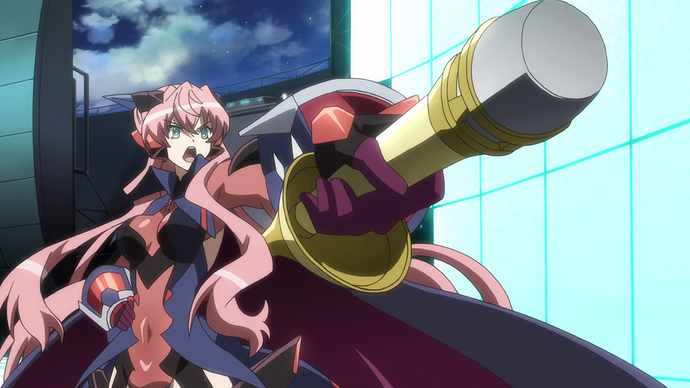
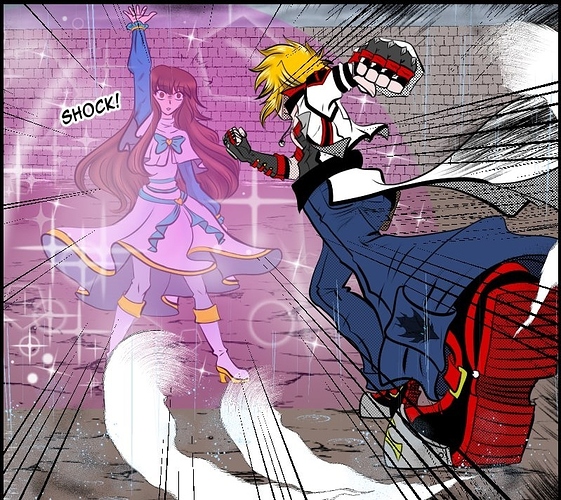
Visual artists are trained to use techniques like playing with focal length--
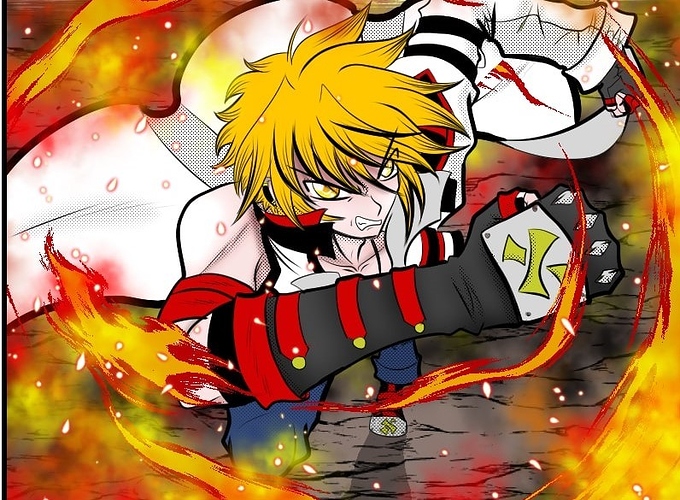
Or playing with airflow--
...To lend interest to otherwise static poses, and to add extra dynamism to more energetic ones. You won't see these techniques used as often, if at all, in live action, because they don't look the same and they don't work the same way. The energy of Pic #2 in particular would be very difficult to replicate with a live model...a real human girl wearing that outfit and doing that pose simply wouldn't look like that.
TL;DR, please study from other visual artists AS MUCH IF NOT MORE than you study from human models (even if your art style is realistic, honestly). If you don't, I promise you will find your art lacking in some areas eventually.
2. Play around and explore
Study is important, and using the skills you've gained in the product they're meant for is also important, but there's a third thing that's important: playing. ^^ You also need to use your skills in a pressure-free environment, where you can encourage yourself to experiment and just try random things. The key word there is 'try': if a doodle isn't going well, let it go and move on. The important thing is to make the attempt, and maybe make it again later.
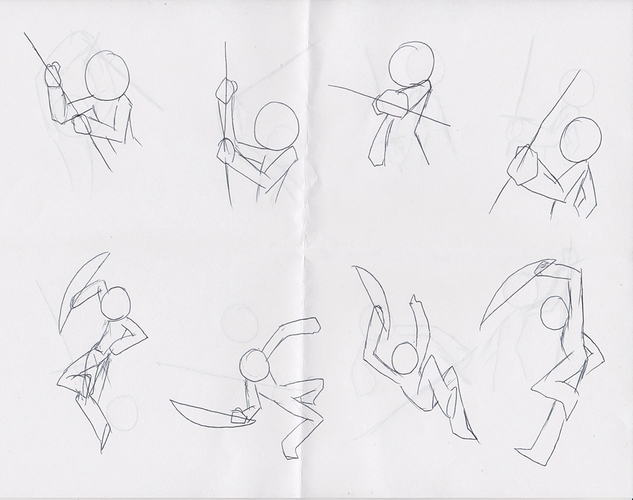
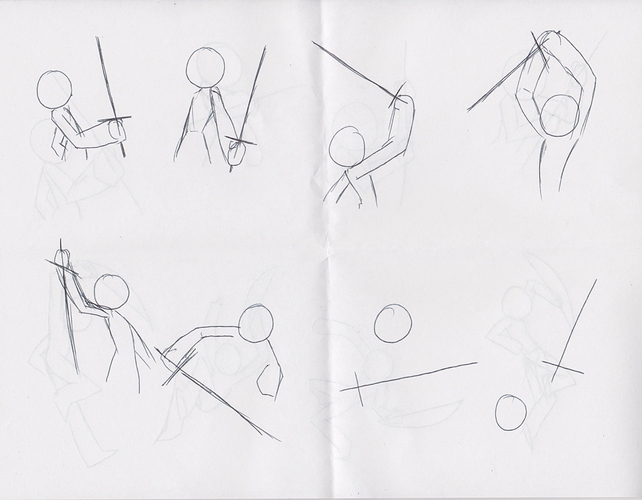
Coincidentally (or maybe because I saw this topic and wondered how to improve my own skills before I left for the day), I came up with an 'idea generation exercise' that would prompt me to create action poses with different weapons, and I started using it today at work. Take a look:
I call them "I&O", "D&O", and "T&O"...you can see how it works in the bottom corner of the second pic. You draw these 'letters' and place them randomly in pairs on the page, then use your artistic skills to connect them into action poses.
'O' is always the character's head, and the other 'letters' were chosen to evoke certain kinds of weapons: 'I' is a staff, or anything that can be held similarly (a flag, a baton, a large handle). 'D' is a large blade, specifically an asymmetrical blade where one side is for holding and the other for slicing. 'T' is a symmetrical sword, or at least one with a clearly defined hilt and guard as part of its shape.
Anyway, you can see that the drawings are very simple and the poses are all different; some from different angles, some with foreshortening and some without. The point is to push yourself to be creative and trust in your skills to make each idea work.
Obviously, this exercise will be most beneficial to those who kinda already know what they're doing. ^^; But I think in a less-experienced artist, it could help to identify weak spots, and build a library of poses to practice and improve upon with specific weapons. I'm already thinking of trying a "C&O" for bows, and maybe an "O&Os" for fist-fighting poses...