Lots of good advice in the OP~. Although I think there are a few other things to consider if you want to make a fight scene really enjoyable: pacing and tone.
In a fight scene, simply describing the back-and-forth trading of blows won't leave the reader with any sense of pace; after a while the scene will feel dull and skippable. But emphasizing certain attacks, strategies, and injuries will give the reader things to focus on, and help build anticipation for how the fight will unfold.
One way to do this is through emotional reactions: the time you allow your POV character(s) to react and reflect on what's happening. If they get hit and recoil just briefly (or not at all) before counterattacking, you're signaling to the reader that it wasn't a serious blow. But if the character is hit and doubles over in pain, screams, and/or needs a moment to catch their breath and figure out what to do next, you're signaling that the blow was more severe by slowing down the pace, and allowing the reader a moment for their own emotional release-- that's what'll keep them engaged.
Alternate between fast and slow-paced moments, saving the slower ones for the most important moments, and you'll create a more immersive scene.
Now, tone is a little more complex, especially when it comes to fight scenes. I've seen pros struggle with this even in visual media; I can't imagine what goes on in prose...but in my experience, you define this through choreography. The types of attacks your characters perform, and their reactions to it. And the reactions from onlookers, if they're around.
Example 1:
I started out by hitting them twice in the jaw, which felt very satisfying. But before I could decide on my next move, they grabbed my hair and pulled my face into their knee.
The next five minutes were a bit of a blur…I remembered stumbling into the reception desk at one point, flipping Paulina over it to finally escape their clutches. I also remembered hearing people shrieking and taking pictures around us, and realizing that I would definitely get into trouble for this.
Paulina made up for their lack of physical strength by using the office furniture as projectile weapons, which did manage to dent my Taxis Cast in a few places. Even if I were willing to fight dirty that way, I didn’t dare add property damage to my list of transgressions…but they had that privilege; their “father” worked there.
Example 2:
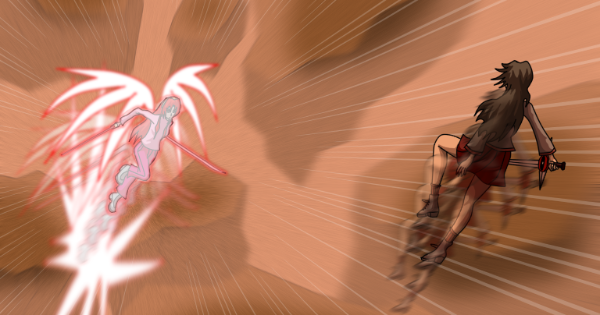
I immediately charged in to kick them in the jaw, getting grazed by more shrapnel in return. But I was confident that my armor would hold, and continued to beat them, knowing that I needed to deal as much damage as possible in that moment.
Eventually, they managed to drive me away by sending a stream of shrapnel directly into my shoulder, shearing it wide open. The crowd gasped (those who were on Team Viktoria, anyway), but I ignored the pain, using another trap-sphere to drag them off balance. Once again, we stood at opposite sides of the arena, staring each other down.
“That’s probably the last time she's going to let me get that close,” I thought, breathing heavily. “I need a new strategy…”
Hopefully, even though the combatants are the same, you can tell which of these is the more serious fight scene. ^^ But let's break down some of the choreography:
In Ex 1, we have hair-pulling-- which feels inherently unserious; mostly because it's considered a "girly" form of fighting. I like it because it feels silly and vicious simultaneously; it's a way to cause your opponent a lot of pain without much effort, turning the bout into a clumsy tug-of-war until they can finally escape. Which the MC does by flipping her attacker over a desk-- even though this is a low-stakes fight, the combatants are highly skilled, and that's still gonna show through occasionally.
In Ex 2, we describe the MC's shoulder getting "sheared wide open", a grisly visual that sounds extremely painful-- even the MC explicitly ignoring that pain doesn't diminish it. In a way, it elevates it, because it tells us that she's so focused on winning the battle that she's willing to look past a grave injury. The crowd gasping (instead of taking pictures like last time) helps with that.
There are other clues that help define the tone as well, like the location (an office environment vs. a literal arena) and the types of thoughts the MC has (worrying about 'getting in trouble' vs. worrying about her next strategy). All these details work together to make the reader feel a certain way about each scene.