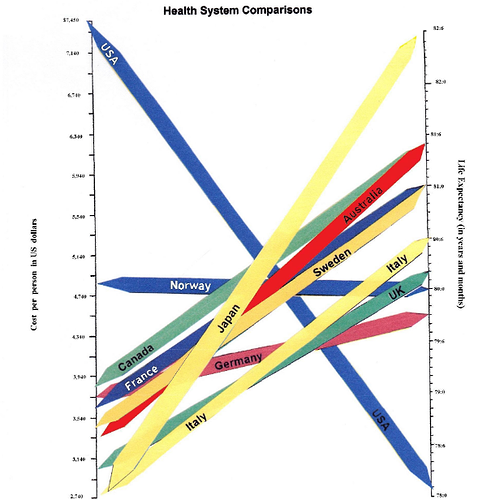
Relax, I wasn't talking about firing doctors or nurses, but more like actually getting what quality is worth our spending out of it at the very least:
I have more stuff that shows how inefficient we are but I like this one the best because it gives more of a comprehending image. There isn't one single reason for this either, the whole system is kind of a disaster area.
One reason that we can't really do anything about is just the fact that we have a lot of old people, the boomers, they are also why social security is expensive as well it's because we have lots of old people who need it, and less workers to pay for it. Not much you can do about that other than just wait for them to die out in the next 10-30 years, in which I guarantee you that the price for both medicare and social security will plummet.
As of right now tho, there are economic inefficiencies that I just don't like.
Diabetic folks are supposedly expensive to take care of, or so you are told, but the reason why those folks are expensive isn't necessarily because of their diabetes, but the insulin they need is way over priced. It costs like 6 bucks to manufacture insulin for one person for one dose, which means it would realistically cost between $78-$133 per person per year, but big pharma decides to charge the US government $1251 per person per year. The diabetic population of America is a little over 30 million people, which adds up to over $37.5 billion per year for the diabetic population of the US. That cost could be 10 times cheaper, a little over 3 billion dollars if the US government had more control and told big pharma to not over charge. This would make insurance cheaper as well, we need a little more than obama care telling insurance companies to cover pre-existing conditions such as that.
And mind you, this is JUST that particular medicine for that particular sort of person. I can't begin to imagine how much more we could save if the government had the ability to control those sorts of prices to more reasonable levels.
There's also this weird thing about hospitals that I don't really understand. Why is it that it costs someone $10,000 to walk into the building and be put in a bed?
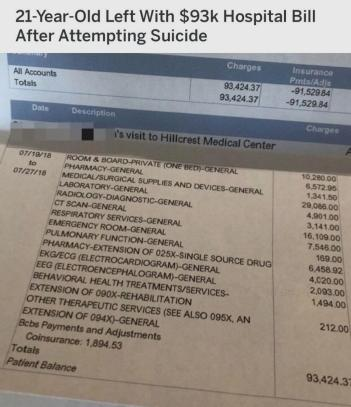
If I rented an apartment here in Oregon with a rent cost of 11% I would only pay $2,000 per month, I can live in one of the more expensive Portland apartments for 5 months before it would ever get any close to as costly as being put in a hospital bed for what looks like is a little over a week:

I'm no doctor, nor do I work at a hospital, so I might be missing something here, but even if that money was being given to doctors for their labor, why charge it as being put in a room and not just have it charged as "labor" or something?
Speaking of labor, Administration costs. That's another money vampire in this charade of ours. For example, there'll be hospitals like Duke University Hospital, where they have hundreds more billing clerks than they do beds to put patients on. Paying workers is a companies biggest expense, the more people they need to pay, the more money they charge the government. If we had a system where we didn't need to have insurance companies and instead had a monopsony where the government just handles it all, we wouldn't have a need for all the administrative costs or even insurance costs because there wouldn't be people with multiple insurers that create varying demands for hospital administration to meet.
And when I say a monopsony, I say that baring in mind that it's not really free health care, but it's just jumbled with the tax dollar, but it at least still cuts the personal costs down by a lot.
Yes, that does mean job losses (especially considering the collapse of health insurance) but those people can find other insurance corporations to work for. This would also mean a greater good because it allows the government to cover everyone in the US.
Defensive medicine: Allow more legal protection for doctors like we do for companies who donate left over food to charities.
And of course the list goes on and on.
Regarding the Veteran's health care Association, that was more of a massive operator error event, it was mismanagement. I'm sure it can be fixed if the government was more organized about it and added reforms to make it better, like keeping an ER system that has the mentality of "Health now, money problems later" that hospitals should have by default as a functioning facility as well as better rationing.
Besides, maybe about 300,000 veterans died under that, and yes that is an ugly amount of deaths due to that system, but consider there's 18 million veterans in that system. If scaled up to all 320,000,000 Americans, you're looking at 5.333 million deaths over the course of maybe 10-20 years or so, that's at most 533,000 deaths per year and at least 266,000. Two to five times more people die from car accidents each year. This is also using numbers from a horribly extreme case that can be fixed to be better than what it is if the people running it were just more competent.
For this next point, I'm going to be using "human years". Just think of it like "man hours" where if I get 60 people to work on something for 2 hours, that'd be 120 man hours. Only instead of hours, it's years, and instead of working on something, it's living a full life.
Compare the health care we have now to the number of years that people could be living if the life expectancy was as high as, say, Japan's but the system we used killed as many people as the VA has.
Our life expectancy currently is about 78 years old while Japan's is 84 years old. To be more harsh on this system, I'm assuming those 5.333 million deaths I mentioned earlier were all infants when they died, and not 20-40 year olds. If 5.333 million infants die in 10 years, each year we lose about 22.3 million man years of life from the health care system. But we also gain 26.88 billion man years total from 84 years life expectancy. Subtracting losses in systemic deaths as well as the amount of man years we currently get, you're left with a net gain of 1.472 million more years worth of human life to live each year by using a government paid system that's as disastrous as the VA instead of our current system.
I know this is a clumsy argument, but I found it hard to get actual reliable statistics on other countries that weren't skewed by big pharma somehow.
Health care, just as a moral thing as well, shouldn't be a privatized corporate controlled asset, especially when you consider that it's the government's responsibility to give right to Life, Freedom and the pursuit of happiness. This in my view is more of a government's responsibility.