-walks out of the shadows- Sweet Baby Jesus, it's my time to shine.
So I have a lot of experience with writing horror. I love the genre thick and through, and even now, I'm still learning how to work with it. It's been incorporated into my other works (hell, Our Universe has turned into a cosmic horror romance, and it's real flexible even if you have a friendly art style.
For me, the key elements I use are unexpectedness, repetition, reaction, and mood. There's also a hint of subtlety, but I like to add a spice of that into all four of these elements.
Unexpectedness
Now sometimes, when people think "unexpected", they think jump scares. And that's kinda part of it. But often times, some of the best unexpected moments are the moments that fit so perfectly into "normal" situations. Both the reader and characters aren't caught immediately off guard. Rather, it takes a moment to register what's happened. Sometimes, it's a sudden mood lash, and sometimes, the mood hasn't switched at all. It's not until there's a delayed reaction or something similar that we realize "oh snap -- what just happened??" What helps hold those moments is that as they happen quick. In a flash, they're there, and in a flash, they're gone. Here's an example from one of my shorter writing pieces:
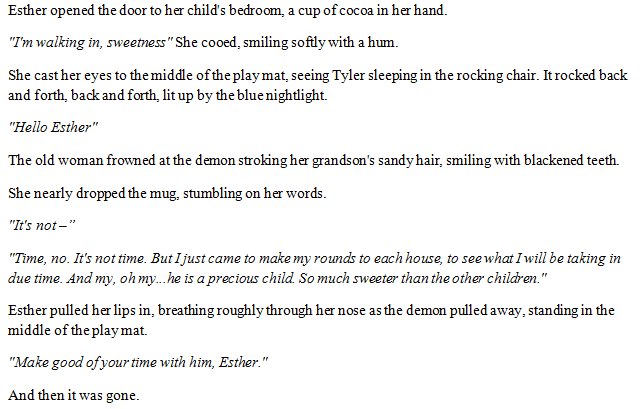
The demon fits right inside the child's room, even though we know and Ester knows it shouldn't be there. It lingers for about a few minutes at best in the story, but during those minutes, you understand that A) what it looks like and B) Ester knows it will take her grandson. It's subtle, quick, but it gets the message across. And just like that, it's gone.
Repetition
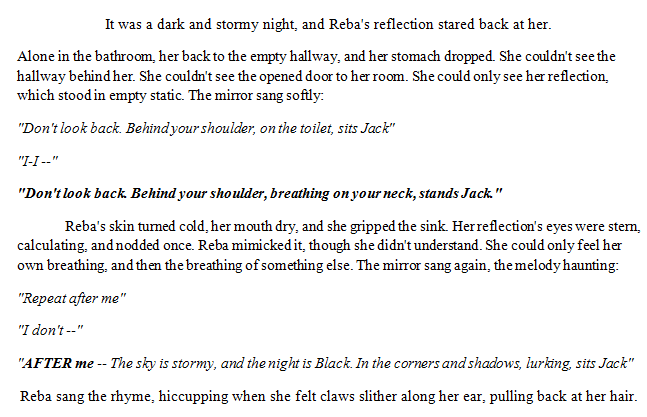
Sometimes, it helps to use repetition to emphasize the importance of key phrases, actions, or dialogue. For myself, I use it a lot for moments when I incorporate rhyming and singing into my horror, as noted down belong:
I also include repetition in my lighter moments in my horror, especially cosmic horror, to hint that things are about to take a turn. Take a look at these examples from Our Universe
(Click to Enlarge)
(Click to Enlarge)
Notice how I've repeated some of the same phrases from the first page of Season 1 to the first page of Season 2? But also notice how some of the words have switched, along with the scenery? It's this kind of repetition that helps to clue in that something's gone wrong. More like a nursery rhyme that keeps repeating until the words go out of rhyme and something else takes place. Combined with new settings, the words take on darker tones and reveal more to the readers. It also hints back to foreshadowing, as the reader is now aware that the scene they saw before probably wasn't its true form.
In horror, repetition is sometimes about making the "normal" abnormal. Something is wrong, even though you know you're hearing the same phrases over and over.
Reaction:
Again, a lot of people tend to focus on the actual horror taking place. So it can be a pit-fall to try and come up with monster designs, ESPECIALLY in cosmic horror. For me? I like to focus less on the monsters and more on the reaction of the characters. I like to evoke the idea that "nothing is scarier", and it helps the readers create their own versions of what the terror looks like. This is an example I used for a shorter piece:
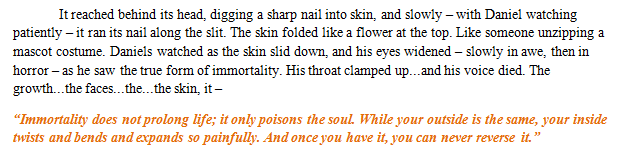
There is a slight hint of what Daniels sees -- faces, skin growth -- but the focus was on his perspective. His body froze at the sight, and I never go into details on what this "immortality" truly looks like. Rather, that is up to the reader to create. But in the end, they do know that what Daniels saw caused him to paralyze in fear.
In terms of art, I had made a light tutorial towards the tailend of last year. For me, it's all about the body language and the way the face moves. I like to do a strong focus on the eyes, even slowing down the motion so that the reader can take it the character's feelings.
(Click to Enlarge)
Mood
This is where the art style kinda comes into play. Now, my own art style is friendly as well. It's a mixture of both anime and cartoonish elements. However, I like to rely on the change of lineart and colors to really help set the mood. This also pairs well with repetition, repeating words that are ok (but not really). I have a bit of examples down here:
(Click to Enlarge)
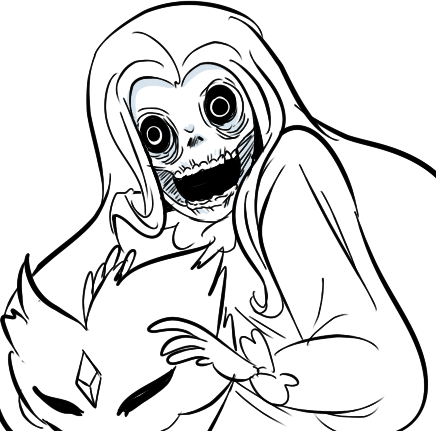
Notice how my lineart has become more rough and seem to be scratch at the surfaces. I also do black shading to kinda hide elements or to make them stand out.
A limited color pallet can really help convey mood -- especially when there's a sudden shift in tone. A lot of my inspiration comes from artists such as Emily Carroll and Junji Itou -- both who have fairly "friendly art" (more so Carroll than Itou) but both knowing how to mix and match lineart and colors and shading to set a tone.
Welp, that's about it from my end! Again, everyone else has really shown some cool tips, and I would highly encourage to continue doing your own research to get the results you'd desire