That's the issue, you're trying to learn anatomy. What you should be doing is copying anatomy. Look up reference poses or play with a super articulated action figure with a base so that you can draw poses.
The difference between a pose that looks stiff and a pose that feels lively is being DYNAMIC!!
The issue with your poses is that looks like the subjects look like they completed an action and are staying still for the camera, awkwardly. Their clothes to straight, stiff and jagged.
Think about capturing moments in time.
Tooting my own horn, look at these poses in my own web comic.
https://tapas.io/episode/1511463
https://tapas.io/episode/1497635
https://tapas.io/episode/1521743
https://tapas.io/episode/1662679
https://tapas.io/episode/2222508
It's about direction.
I've drawn up some crude drawings to demonstrate.
To avoid copyright infringement, let's call them Dirby.
As you can see demonstrated below, I have Dirby looking up, which pose looks dynamic?
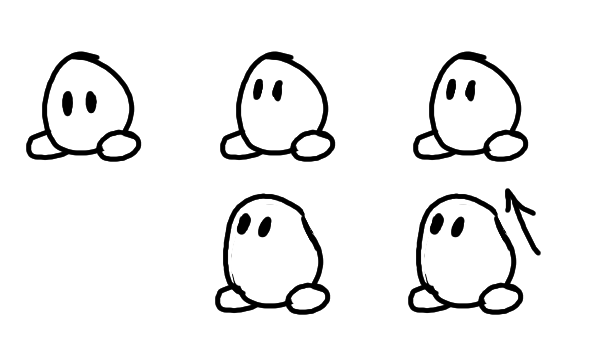
If you chose the bottom one because of the arrow, then you'd be right. Because when Dirby looks up, Dirby also moves their body along.
Next let's look Dirby run, which of the following looks like Dirby is running?
If you chose any of the latter two, then you'd be right.
What's the difference? In the first image, Dirby has their legs at each side, which might imply a walk or a trot, but not a definite.
The second image implies that Dirby is having a nice casual stroll. Not really running. Notice the eyes and how it's pointing away slightly from the direction that Dirby is walking towards.
In the third image, you can definitely tell that Dirby is running. Eyes pointed in the direction that they're heading towards and feet in a position as if they're switching between strides.
Next, move on to something more humanoid, we'll call this Dirby's brother, Dod.
I don't have to ask which image looks more alive. It's the one on the right. How come though? Not because of curves, but because of implied motion. The way Dod tilts implies that he shifted his weight in a 3D space. Even though Dod is not animated, you can assume that Dod did in fact tilt and shrugged his shoulders. The magic of the human brain is that it looks at things and it makes connections before you even realize it.
This image represents engagement. Something that should be carried in from theatre to comics is to NEVER turn your back to the audience. It breaks engagement and leaves the audience alienated. You want your audience to feel what your character is feeling. You want the subject feel alive, not be alive.
Final case, exaggerate. Just because you have a pose down, doesn't mean it conveys what you're trying to say or what you're trying to picture. Body language is a huge factor in comics. Imagine that your audience can't understand what your comic is saying because it's in a foreign language of sorts. What's the next best thing that they can interpet? Body language!
Take for instance this Scrooge McDuck Comic. You probably don't understand what they're saying, but you can probably interpret from the body language what is going on.
So if your character is afraid of something or cowering at the thought of something, make it so that they dread the thought of it. As if the thought itself was real and that they're physically cowering away from the thought to the point where they have to sink down, maybe lift their feet up, slowly scrunch into a fetal position because that's the last place that they were last comfortable in.
So what's the lesson here?
Anatomical poses =/= Dynamic Poses!
Your poses need intent, purpose, and most of all DIRECTION!!
Thank you for coming to my Ted Talks.
If you haven't already, please visit my webcomic Zeta Bits for zany poses that POP!!


