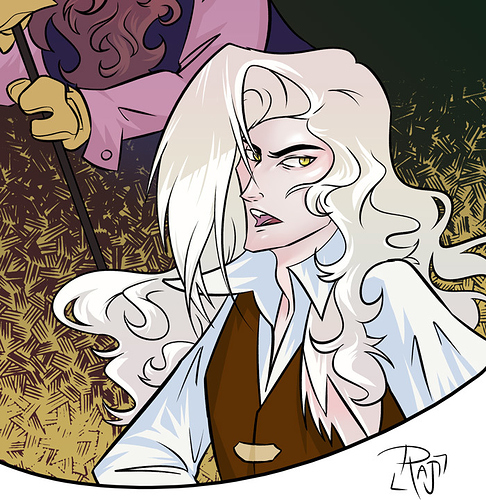
It took me a while to enjoy cel shading because I come from a painting background, and something I really learned is that there's really a brain thing where it's hard to think like "oh I have to do linework, and be a totally different artist" but that's not how it is. You can still approach cell shading like it's painting. When I do linework, I tend to treat it like brush strokes, which is kind of weird to explain without showing, I guess--but all that matters is I end up with clean linework I like at the end. That's what cell shading needs--clean lines that draw the outside of what's important.
That's totally doable from a painter's perspective (and something we practice a lot since painters have to make sure to do each stroke very carefully--you don't scribble when you paint because...that ruins your paper, and paper will not forgive you. So I think that going from painting to drawing is pretty beneficial in the long run since you already practice not doodilating stuff.) So when I'm brainstorming and laying out stuff, (this is early versions of my main dude, Djali) it's mostly painterly,
until I decided to go switch over from brainstorm mode into production mode, and he got edited down into this:
And like with illustration we don't really talk a lot about pipeline, which is the method you use to create a piece, because it's not important unless you need to be fast or you work with other people who need to share your files and know what's going on (and a lot of illustrators work alone and at a fairly casual pace.) But for comics, because you draw something a lot, you need to make a pipeline that never changes (unless you're changing it to be faster.)
I studied more succesful comic artist's pipelines and basically stole it, TBH. Like, there's a reason why their pipelines work: I do penciling, then I do linework, then I do flatting (which is when you make a selection for each area of color) and then I color the flats on a seperate layer, and then do the highlights with clipping layers (which is not required, you absolutely don't need to do any shadows in a comic, if you don't want to). But, you can definitely tell Djali's got painterly origins, but I only kept it in places it wouldn't hold me back (so mostly on the shading of the face, because doing harsh lines on the face bothers me)
That and for backgrounds? If they're very organic like trees and stuff: I just straight up paint those, haha. So sometimes as I'm doing linework, I'm thinking "this will be flat later" and other times I'll think "this area will be painted later. I don't need to do linework for this."
But honestly I didn't "get" linework until I did a comic. So I super recommend it. It's a trail by fire in a lot of ways, I'm constantly like "holy...how am I not better at this by now" but it does get better as you go because there's a pipeline and a time limit. The more you do it, the faster you get, and the better you'll get.