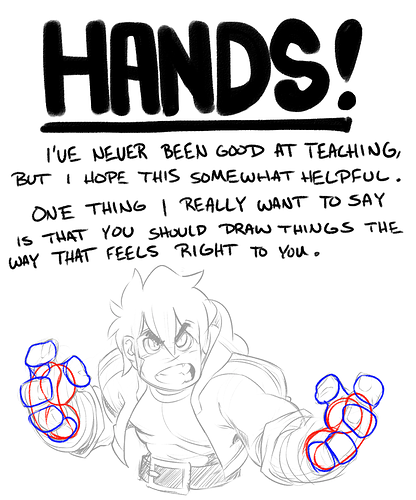
I approach hand drawing in a very structural, methodical way (as I do with most things I draw).
While I would normally recommend doing anatomy studies, I think one of the interesting things about hands is that you can map the skeleton and muscles correctly with ease, and still have difficulty conveying what an actual living hand looks like in motion, or how people express themselves through hand gestures.
This way of studying has helped me a great deal more:
Look at your own hand. Try slowly moving it into a series of different positions. Now, pay close attention to not only the surface level appearance, but the feeling of what you are actually moving. Perhaps even imagine that you are building a robotic hand that needs to replicate the same gestures in the most efficient way possible. Instead of seeing hand drawings as static gestures, pretend that you are drawing machine blueprints.
As an example, I've drawn quite a few different hand gestures on the pages here:
and here:
Most of my attention in these panels is on how the hand exerts pressure. How is it in contact with the thing it's touching or holding? What muscles are engaged to complete the task? I figure this out by doing it myself, and taking note of how it "feels" to button a shirt or squeeze a cane-like object. References help too, of course- but without this additional "insider info" about how it really "feels" to perform that specific action, I think the resulting drawings can come off looking as if the hands are sort of free-floating, and not really in contact with the thing they're doing, similar to how if you don't consider weight or volume in animation, even rotoscoping- drawing directly over top of live action- can leave the result feeling a little "off".
Long story short I absolutely love drawing hands, so feel free to hit me up with some questions! Of course I also have a long way to go and plenty to learn