I’m expecting this one to be a 50/50 split. ^^ It’s really a matter of taste:
So my vote is True, but not for the reasons most people spout…everyone whining about “cringe Gen Z slang” and “dialogue should be timeless”  move to the other side of the room, please. We are not talking about the same things.
Not that I completely disagree; cringe is a problem. But if your argument stops at ‘cringe bad’ you don’t really have an argument, just a surface-level observation. And the ‘timeless dialogue’ thing is just nonsense; I’d even go as far as saying there’s no such thing, and the insistence on it feels like a culture war dogwhistle. :T
ANYWAY– Personally, I prefer to go with the Occam’s Razor approach. The biggest hurdle to getting an indie animation project off the ground is the animation itself– thus, most successful indie animation projects are helmed by animators, not writers. Pair that with a general societal disdain for writing as a skill/profession (i.e. everyone thinks writing is easy and that they already know how) and you get what we got– an evolutionary explosion of projects that are conceptually and visually interesting, but narratively weak, with amateurish dialogue and characterization.
Especially when compared to the pro-level presentation: it’s easier and more affordable than ever to make a show look and feel like an industry production…until the characters start talking, and the spell is immediately broken and replaced with an almost uncanny-valley sensation.
I think ^that’s what pisses people off the most. ^^; To be perfectly honest, what people think of as ‘indie writing’ (i.e. Vivziepop, pretty much) is not that widespread, when you consider the true breadth and diversity of indie projects. I think it’s that visceral feeling of audio-visual incongruity that people are actually picking up on, and then they hear a character say one too many swear words and blame it on that. And then we end up with crowds of people complaining “all these indie cartoons have too much swearing!” when what they really mean is “all these indie cartoons never sound right; I just can’t put my finger on why”.
Basically: I agree that indie cartoons tend to have glaring dialogue issues. But they’re more complex than they seem, and honestly unique to the production most of the time. Some shows treat dialogue as a vehicle for shallow characterization and very little else (Helluva/Hazbin); some shows only use it well for certain characters, while hanging the rest out to dry (KoG); and some just lose a bit of their grasp on it whenever the tone changes to ‘sad’ or ‘serious’ (Digital Circus, imo…the characters are often at their least engaging during their most important moments, with the exception of ‘negative arc’ characters like Jax and Caine. Makes me worry about the finale, tbh).
And then the more general issues are usually just bad habits that come from writing in insular environments. Like relying too much on references (as opposed to setting up and executing your own jokes…), relying too much on shock value/randomness (just because you can make your friends laugh with it doesn’t make it comedy…I promise, it will not sound the same coming from a fictional character in a scripted convo), relying WAY too much on 4th wall breaks (again, your audience are not your friends…constantly wink-wink-nudge-nudging at strangers looks desperate and pathetic), and the true story killer, ‘fanfic-minded’ writing (i.e. refusal to establish characters or properly worldbuild because you assume your audience already knows and loves everything you’re writing about).
^These things suck, yes. But they’re not actually limited to indie projects; you see them all the time coming from the highly-insular environments within established studios. ^^; As a wise YouTube commenter once said:
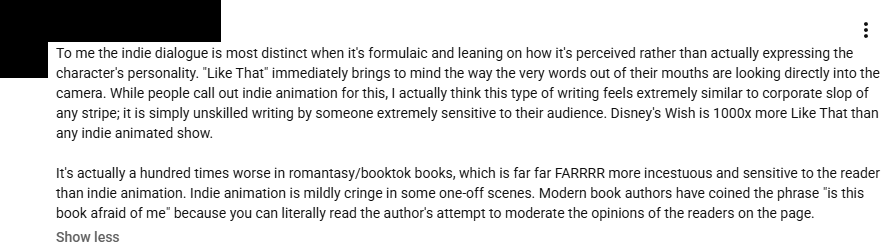
…And I agree 100%. I dunno if I mentioned it in that other thread, but that’s the main reason I haven’t read any work of fiction published in the last 10 years; one whiff of that “now, I know what you’re thinking, but–” writing and I’m immediately too repulsed to get past the synopsis. >_< If your story is just a thinly-veiled instruction manual on How To Correctly Appreciate All My Ideas, then you are writing for an audience of idiots, and I do not want to join.
I haven’t really seen ^that in any indie shows yet (thankfully), but I’ve definitely seen writing that, conversely, seems so over-eager to impress the audience with every line of dialogue that it rapidly becomes unbearable. Because if every line is impressive and memorable, none of them are; you are turning your cast into tryhards. ⚆‿⚆;
Like, if you want my advice: the secret to ‘natural sounding’ dialogue is not vernacular, it’s just ratio and intent.
Most people’s everyday speech is simple and boring. Save the ‘zingers’ for high-energy moments and actual comedic timing; 75% of your characters’ dialogue should be written and delivered as if it’s nothing special. Because normal people don’t think everything they say is special; they just want to get their point across. ^^;
Similarly, if you want a character with weirder dialogue to sound natural, you have to make it clear that the way they talk is boring to them. A character who drops an F-bomb every 2 seconds will still sound believable IF, and only IF, you resist presenting it as something the audience should be ROFLing over. Don’t pause for laughter, don’t make it a punchline; have your VA deliver it as casually as breathing, and you’ll pull it off.
Of course, studying the way different kinds of IRL people talk will help (and it’s something I don’t think people realize writers have to do…). But at the end of the day, people– and by extension, characters– are interesting mainly because of their actions, desires, and personalities; the specific things they talk about, not just the way they speak. So if you focus your effort on the main things, I think you’ll get fewer ‘cringe’ complaints across the board.


