So, Full disclosure: I've been through my share of figure drawing courses from high school through college, so a good portion of my knowledge comes from there. However, they aren't everything, and I'm still learning to this day. These days, I get my anatomy references and sources from a variety of places.
Books
I have three books on the subject, and they all have varying levels of 'art-centric' information.
Anatomy for the Artist, by Daniel Carter and Michael Courtney, is entirely art-centric. It focuses largely on surface-level and proportion stuff, and gives tips for how to draw/shade areas. It's somewhat lacking in the deeper details regarding muscles and bones, though.
Anatomy for the Artist (yes, exactly the same title, so the author matters a lot), by Sarah Simblet, is a hybrid of anatomical details and art-centric advice. It's a coffee-table style book, so it's large and full of large, full-color photos, often of very fit people (i.e. Olympians, etc), and some of the photos have a vellum overlay that shows how the bones/muscles fit/lay under the skin and flesh of a limb. Beautiful book, but there are some explicit photos as it does deal with genitalia for a page or two.
Atlas of (Human) Anatomy, by TAJ books, is not art-centric at all. It is strictly an anatomy/medical reference book, but it's super useful if you're trying to figure out 'okay, is there a major artery there? Or a nerve? What might get hit if my character gets stabbed/shot there?'
Stock photos.
If I'm going to use references for a pose or something to get the anatomy right, I use photos of real people, not 3D models, because I don't trust 3D models to accurately bend/squish/stand/balance the way a real person would. (For example: CAN a real person do a stereotypical boobs/butt pose? Maybe. Would anyone ever naturally end up in that pose in anything but the most unlikely and contrived circumstances? NO. It HURTS.) I use Google image search for a lot of things, but classics like Adorkastock are great too. And TBH, if you find a really great pose somewhere... save it to reference later. Build up a file of reference material.
Google images are also great for looking up medical illustrations-- like if you just want to know where X muscle attaches on Y limb when it's turned a certain way.
Friends and self
If I just cannot find good reference for, say, a particular hand gesture, I'll just do it myself and take a photo with my phone. (Or if my hand isn't a good match for the hand I'm trying to draw, I'll ask someone who is.) I have used myself and my housemates as reference models many times, because you can be SURE you're getting the pose/angle you want, from a real person.
Extra credit:
Anatomical Museum exhibits.
So, this one isn't for everyone. Some people are morally opposed to it, others are afraid/grossed out, and others don't have the financial or logistical opportunity even if they'd like to attend... but exhibits like Body Worlds, or other preserved cadaver exhibitions are the sort of anatomy study opportunity you're unlikely to ever get anyplace else. I went once, and absolutely drew my way through the exhibit. I have some really incredible muscle references of people doing things like ballet, ice skating, and soccer, that I just could never have gotten any other way.
DIY mannequins.
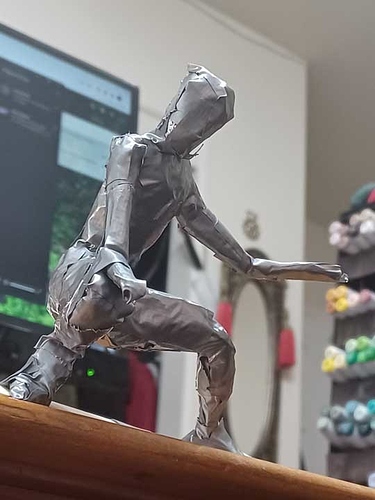
I didn't have a mannequin, couldn't find a good reference, and trying to get a photo of myself doing this exact pose was impractical at best. So I built a mannequin out of popsicle sticks, foil, and duct tape. Worked pretty well.