You deal with plotholes and an unclear plot by studying story structure. If you don't know how to craft conflict, you won't know where to go with a plot, no matter how interesting the characters are.
I'm not talking about formula one-sheets or hard and fast rules that such-and-such trope HAS to be included cause you're writing in the such-and-such genre. These things are not plot, they're examples of window-dressing that groups of stories have in common. Inevitable, and yet able to be reworked in interesting ways because of the specific context in good stories.
I'm talking about the principles of storytelling that have worked before and will work for you.
I'm not going to lie, I can summarize what's worked for me but it'll only be a drop in the bucket because my creative flow is predicated on a study of the following books (and i'm still studying storycraft with more resources and changing my processes as I learn more):
Joseph Campbell >> He explains the Hero's Journey, wrote Hero with a Thousand Faces
Ray Bradbury's Zen in the Art of Writing
Stephen King's On Writing
Robert McKee's Story: Substance, Structure, Style and the Principles of Screenwriting (why screenwriting? Cause Comics is a visual medium just short of animation and more than Plays and Novels in the spectrum of pure writing to pure physical visual drama)
The Snowflake Method created by Robert Ingermanson
Blake Snyder's Save the Cat
and a LOT more, not just books but a TON of online researched sources, youtube videos and more.
And not just studying, but applying what I have learnt. My core process is heavily built on the Snowflake Method and McKee's principles from his book because I'm interested in only making webcomics.
I start from the core premise (a Logline/1-2 sentence PREMISE that has a hint of irony to it and thus shows there's more to a story.)
- So not something like "Rose meets and falls in love with Jack.", but more of something like, "Rose, an assassin, is in love with the man she's supposed to kill next, Jack". It rings of irony because the conflict is written into that sentence. You can virtually see how the conflict is going to make things difficult for what Rose would really want. (Save The Cat has a really great chapter on how to make a hook like this. Again with basic principles, not rules.)
From that Core, I start to both Outline ideas for the story as it unfolds while at the same time filling in background information as I need to.
- The Setting, the era, the time-span of the story itself, the locations, the politics of power they have to deal with.
- And also information about the characters core: What are their desires? What are they willing to live for? What are they willing to DIE for? What are the routines of their lives? What's their Biography? What's their Backstory? and so on and so on (it's detailed in Story by McKee in a later chapter that expands on Setting.) The questions you ask and need to research vary from story to story.
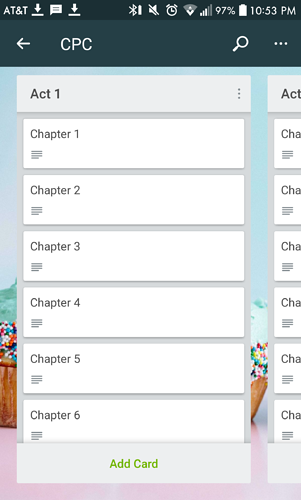
The Outline is then organized in terms of an overarching structure of Acts, with rising action, climaxes/turning points where something meaningful changes from a positive state to negative or vice versa.
- I make sure that my conflicts are actually dilemmas, that is not a choice between something obviously good or bad from the character's perspective (Cause a character will ALWAYS do what they think is Right from their personal worldview), but a choice between two incomparably GOOD things OR, a choice between the lesser of two EVILS. That means the conflict has built-in sacrifices involved, it's got stakes!.
The Outline has an excess of scenes by double or triple the amount I'd need for the story. Entire possible scenarios are torn out when better ones are worked out.
Work is fast and loose and nothing is sacred to the story, only what works. Only what adds to the conflict and stakes and brings out who the Characters truly are.
That way, things that don't work are thrown out. Variations on troublsome scenes are made and only one of possibly ten or fifteen are kept.
This outlining stage is vital because if you can make a summary based on this that can be told to a friend in 10 minutes or less, you can figure out at this stage whether or not the story actually WORKS. Long before you put in the 100s of hours it takes to actually expand and develop the whole dang thing.
The Final Outline is structured by Acts, Sequences, and Scenes, which are written in 2-parts (2 sentences):
- What happens and How it changes the situation for the character.
If the begining and ending of the scene have the character in the same dang place, it's just exposition. It gets cut out and the necessary information is slid into a scene where something actually happens.
Change is the primary prerogative of any story (unless you've practiced enough with storycraft to start breaking the principles consciously). But MOST stories require some kind of change in the principal character's situation from the beginning to the end in a Permanent and Irreversible way.
This process of outlining to excess means I discover everything I need to know about the story long before I start writing the Treatment (A scene by scene description of all the actions and Subtext, no dialogue) and finally the Script (which is concise only because my treatment was so detailed and with the dialogue that is reflective of the subtext).
And even then, I keep learning things about my story throughout the treatment and Script too! Scenes still change, or get added or taken away in later stages. Nothing is sacred, only keep what works. This is the true meaning of "kill your darlings".
It really is true that you end up with far more information about the story than what ends up being presented, and this is necessary. More than necessary, it's vital because in order to be Authentic, you must tell your story with Authority, which means knowing the little universe you've created inside and out. That's what makes someone an Author.
I hope this helps.