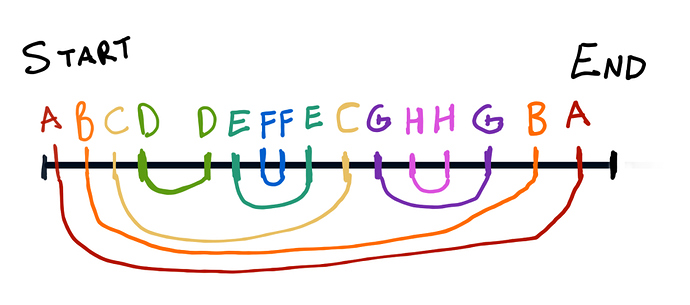
Besides the commonly known three-act one. Has anyone ever tried to analyze and condense other formats of storytelling the same way?
As much as I love analyzing things, I don't really read enough to answer this one. 9u9; And since I write so much action-adventure fare, a lot of my stories can easily fit into the three-act structure from an outsider's point of view.
I don't write them with that in mind, though. ;]
From a planning standpoint, my stories have a very basic Make Problem->Solve Problem structure. I come up with issues that the characters can face, and weave them in as they become relevant. The smaller issues closer to the character in question usually come first (like the typical anime 'I'm late for school!' bit...it's actually a great way to get a story started; the trick is to make the 'mundane introductory problem' character-specific and interesting).
As the story goes on, I introduce more problems, and the characters sort of pick which ones they gravitate towards. Meanwhile, I weave bits and pieces of the 'main problem' into the story in the background.
Eventually, the Climax comes: the main problem finally becomes too big to ignore, or something dramatic happens that makes the characters realize What's Really Going On(TM).
After that is what I like to call the Scramble~. The characters must quickly figure out how they can solve this problem with the resources they have available, or whether or not they need outside help. I am usually figuring it out right along with them at that point. XD
Then come the Loose Ends: lingering problems that weren't solved before, and are now made worse by the main problem. This is the most dramatic part of the story, if I'm gonna kill MCs this is usually when it happens. ^^
After the Loose Ends have wreaked all the havoc they can, the protagonist (often alone and traumatized by now) is left to carry out the Resolution: kill big problem with bigger sword. More or less. :9
That's pretty much it. In 3-act terms, it'd be like a story with a reeeeeeeaaaaally long Act 1..although I still wouldn't ideally use that method to deconstruct them. From what I've seen, 3-act assumes intent with the motions of the story: earlier events 'preparing' the reader or characters for later ones.
It doesn't really focus on 'f*cking around in the sandbox' and discovering new things to think about, which is what most of my stories depend on. If the characters and reader aren't given that time to experience and understand the world where the story takes place, the later Scramble is either going to look like a Deus ex Machina or fail completely.
TL;DR, here is Doki's patented Problem Solver story structure:
Introduction->Minor Problems and Exploration->Main Problem->Scramble->Loose Ends->Resolution
I'd love to hear about your own story structures, or the many potential research-supported ones that I've never heard of.